Transcription on OpenRouter
OpenRouter ·

You’ve got a 40-minute sales call recording, a folder of voice memos, or a user holding down a mic button, and you need a text transcript. The usual approach is to stand up a Whisper server or add a second provider SDK just for speech-to-text, on top of whatever already handles your chat traffic. On OpenRouter you can send the audio to POST /api/v1/audio/transcriptions instead and get back JSON with the transcribed text and a usage object, using the same API key and auth as Chat Completions.
You don’t need a new SDK or a separate service. Because transcription runs on the same platform as your chat traffic, a model hosted by several providers is load-balanced across them automatically instead of being pinned to a single vendor.
Tl;dr
- Transcribe by sending base64-encoded audio to
POST /api/v1/audio/transcriptionsand reading JSON text plus ausageobject off the response. It takes the same Bearer key as Chat Completions. - Whisper-class models work here (the slug is
openai/whisper-1). Newer token-priced speech-to-text (STT) models exist too. Discover them with?output_modalities=transcription, not the default catalog. - When a transcription model is hosted by more than one provider, we load-balance across them automatically. The per-request routing controls you use on chat (
order,allow_fallbacks,data_collection,sort) are not applied on this endpoint today; the provider block here carries provider-specific options only. Bring-your-own-key (BYOK) routes to your own provider key for the platform fee only. - The real limits to design around are a 60-second upstream timeout, no audio URLs (send base64 JSON, or an OpenAI-style multipart file up to 25 MB), and no SRT/VTT output. Word and segment timestamps are available with
response_format: "verbose_json"on OpenAI-compatible providers. - Pricing is duration-based or token-based depending on the model, with no provider markup. The
usage.costfield returns the actual per-request cost so you can meter spend.
How do you transcribe audio on OpenRouter?
Send base64-encoded audio to POST /api/v1/audio/transcriptions and read the text field off the JSON response. You pass your OpenRouter API key as a Bearer token exactly as you do on a chat call, set a model, and hand it the audio.
The response is JSON with a text string that holds the transcript and a usage object that reports the audio duration in seconds, the token counts, and the dollar cost of the request. You make one request, and the transcript comes back in the response body, so there’s no polling and no job ID to track.
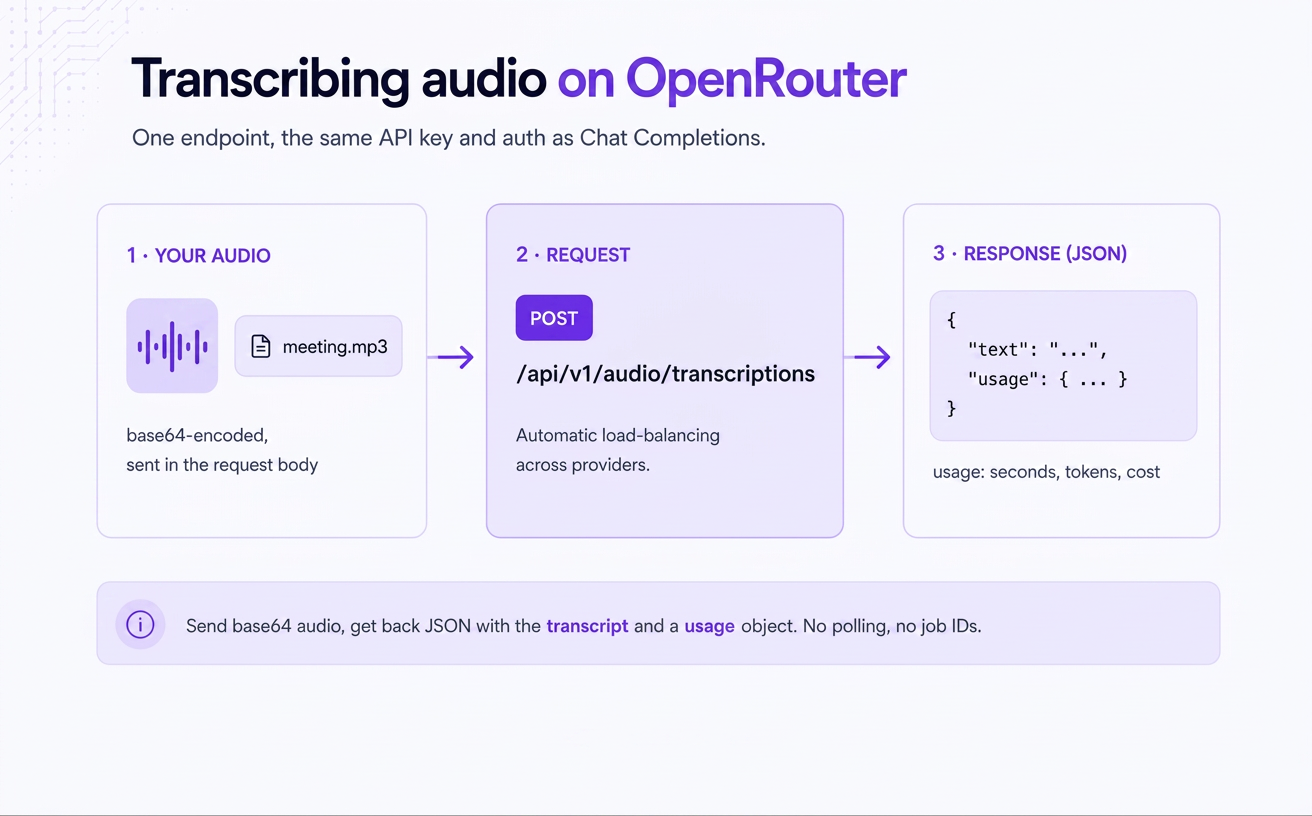
The request body carries a model and an input_audio object. Inside input_audio you put the file as base64 data and a format string. Optionally, you add a language hint, a temperature, and a provider block. Here it is end-to-end:
# Encode the file to base64, then POST it.
AUDIO_B64=$(base64 -i meeting.mp3 | tr -d '\n')

curl https://openrouter.ai/api/v1/audio/transcriptions \
  -H "Authorization: Bearer $OPENROUTER_API_KEY" \
  -H "Content-Type: application/json" \
  -d '{
    "model": "openai/whisper-1",
    "input_audio": { "data": "'"$AUDIO_B64"'", "format": "mp3" },
    "language": "en"
  }'
import base64
import os
import requests
with open("meeting.mp3", "rb") as f:
audio_b64 = base64.b64encode(f.read()).decode("utf-8")
api_key = os.environ["OPENROUTER_API_KEY"]
response = requests.post(
"https://openrouter.ai/api/v1/audio/transcriptions",
headers={"Authorization": f"Bearer {api_key}"},
json={
"model": "openai/whisper-1",
"input_audio": {"data": audio_b64, "format": "mp3"},
"language": "en",
},
)
print(response.json()["text"])import { OpenRouter } from '@openrouter/sdk';
import { readFileSync } from 'fs';
const openRouter = new OpenRouter({ apiKey: process.env.OPENROUTER_API_KEY });
const audioB64 = readFileSync('meeting.mp3').toString('base64');
const result = await openRouter.stt.createTranscription({
sttRequest: {
model: 'openai/whisper-1',
inputAudio: { data: audioB64, format: 'mp3' },
language: 'en',
},
});
console.log(result.text);Which speech-to-text models are available?
You can pick from two families of models. Whisper-class models like openai/whisper-1 are priced by duration, per second of audio, while newer speech-to-text models are priced per token. Which one fits depends on your accuracy bar, your language mix, and your budget.
STT model IDs don’t show up in the default /api/v1/models catalog. That’s expected, because transcription is an output modality you filter for.
curl "https://openrouter.ai/api/v1/models?output_modalities=transcription" \
  -H "Authorization: Bearer $OPENROUTER_API_KEY"
That returns the speech-to-text models with their current per-model pricing. The same list lives in the Speech-to-Text collection if you’d rather read it as a page, and the model catalog carries live per-model rates.
If you want to try a model before you wire it up, the OpenRouter Playground transcribes an uploaded file in-browser.
The field-by-field request contract
The whole flow takes three steps. You base64-encode the file, POST it with a model and a format, and read text and usage off the response. The data field takes raw base64 bytes, not a data: URI, so don’t prefix it with data:audio/mp3;base64,. The format field is required, and it tells the upstream model how to decode those bytes.
| Parameter | Required | What it is |
|---|---|---|
model | Yes | STT model slug, e.g. openai/whisper-1 |
input_audio.data | Yes | Audio as base64 (raw bytes, not a data: URI) |
input_audio.format | Yes | One of wav, mp3, flac, m4a, ogg, webm, aac |
language | No | ISO-639-1 code (en, es, …). Auto-detected if omitted |
temperature | No | Sampling temperature, 0 to 1 |
response_format | No | json (default) or verbose_json, which adds task, language, duration, and segment timestamps (OpenAI-compatible providers only) |
timestamp_granularities | No | ["segment"] or ["word"] with verbose_json; word adds word-level timestamps in a words array |
provider | No | Provider-specific options passthrough (e.g. Groq prompt). Per-request routing controls are not applied on this endpoint |
The endpoint also accepts OpenAI-style multipart/form-data uploads (file plus model), capped at 25 MB. If you already have a client built for OpenAI’s /v1/audio/transcriptions, you can point its base URL at https://openrouter.ai/api/v1 and it works unchanged. Files bigger than 25 MB go through the base64 JSON path.
A language hint is optional. If you leave it out, the model detects the language; setting it removes some ambiguity on short or noisy clips. Some providers accept their own extras through provider. Groq, for instance, takes a prompt for expected vocabulary via provider.options.groq.prompt, which helps with proper nouns and jargon the model would otherwise mangle.
The response and its usage accounting
The response is JSON with a text string and a usage object. The usage object is what lets you meter spend per request instead of estimating it.
{
  "text": "Thanks everyone for joining. Let's start with the Q3 numbers.",
  "usage": {
    "seconds": 9.2,
    "total_tokens": 113,
    "input_tokens": 83,
    "output_tokens": 30,
    "cost": 0.000508
  }
}
That cost value is an example from our docs, not a price quote; your actual cost depends on the model and the audio length. The usage object reports seconds (audio duration), the token counts, and cost in dollars. The response also carries an X-Generation-Id header you can log to track or debug a specific request later.
When to use transcription vs. audio input or text-to-speech?
Use /audio/transcriptions when you want audio turned into text, and audio input on chat when you want a model to reason about the audio.
The transcription endpoint fits meeting notes, voice commands, captioning, and searchable archives of calls or podcasts. If you want sentiment on a support call, a Q&A about what was said, or audio mixed with other modalities in one prompt, use the input_audio content type on /chat/completions. Turning text into speech is a third, separate endpoint.
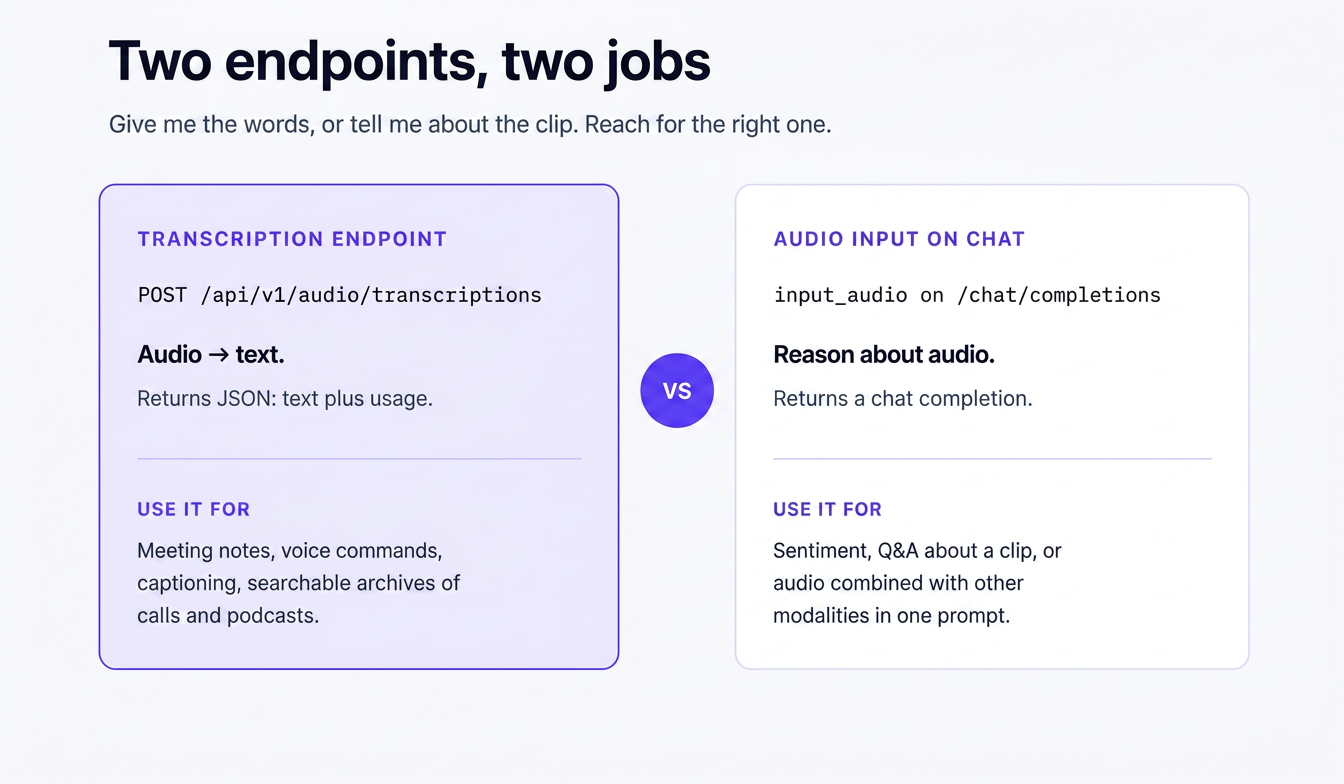
| You want… | Use | You get |
|---|---|---|
| Audio turned into text (a transcript) | POST /api/v1/audio/transcriptions | JSON text plus usage |
| A model to reason about audio (sentiment, Q&A, multimodal) | input_audio on /chat/completions | A chat completion |
For both audio analysis and text-to-speech, see the audio APIs announcement.
How does provider routing work for transcription?
Transcription uses the same routing layer as chat. When a model is hosted by more than one provider, we distribute your requests across them, load-balanced by price, so you aren’t pinned to a single vendor. What transcription doesn’t expose today is per-request routing control. The order, only, allow_fallbacks, data_collection, and sort fields you’d set on a chat call are not applied on /api/v1/audio/transcriptions. The provider block on this endpoint carries provider-specific options instead:
{
  "model": "openai/whisper-large-v3",
  "input_audio": { "data": "<base64>", "format": "wav" },
  "provider": {
    "options": {
      "groq": { "prompt": "Expected vocabulary: OpenRouter, API, transcription" }
    }
  }
}
That request passes Groq a vocabulary hint for proper nouns it would otherwise mangle. The options are keyed by provider slug, and only the matched provider’s options are forwarded. If you need to pin a specific provider or enforce a per-request data policy on a transcription, that control isn’t available on this endpoint yet. The full provider object is documented in the provider routing docs.
OpenRouter doesn’t mark up provider pricing, so the catalog rate is what you pay, and Zero Completion Insurance means a transcription that fails isn’t billed. If you already have a provider agreement, BYOK lets you route through your own provider key and pay only our platform fee instead of the per-usage model cost, with the fee waived for the first 1M requests a month on pay-as-you-go.
What are the limits to plan around?
Four constraints shape how you structure a transcription call:
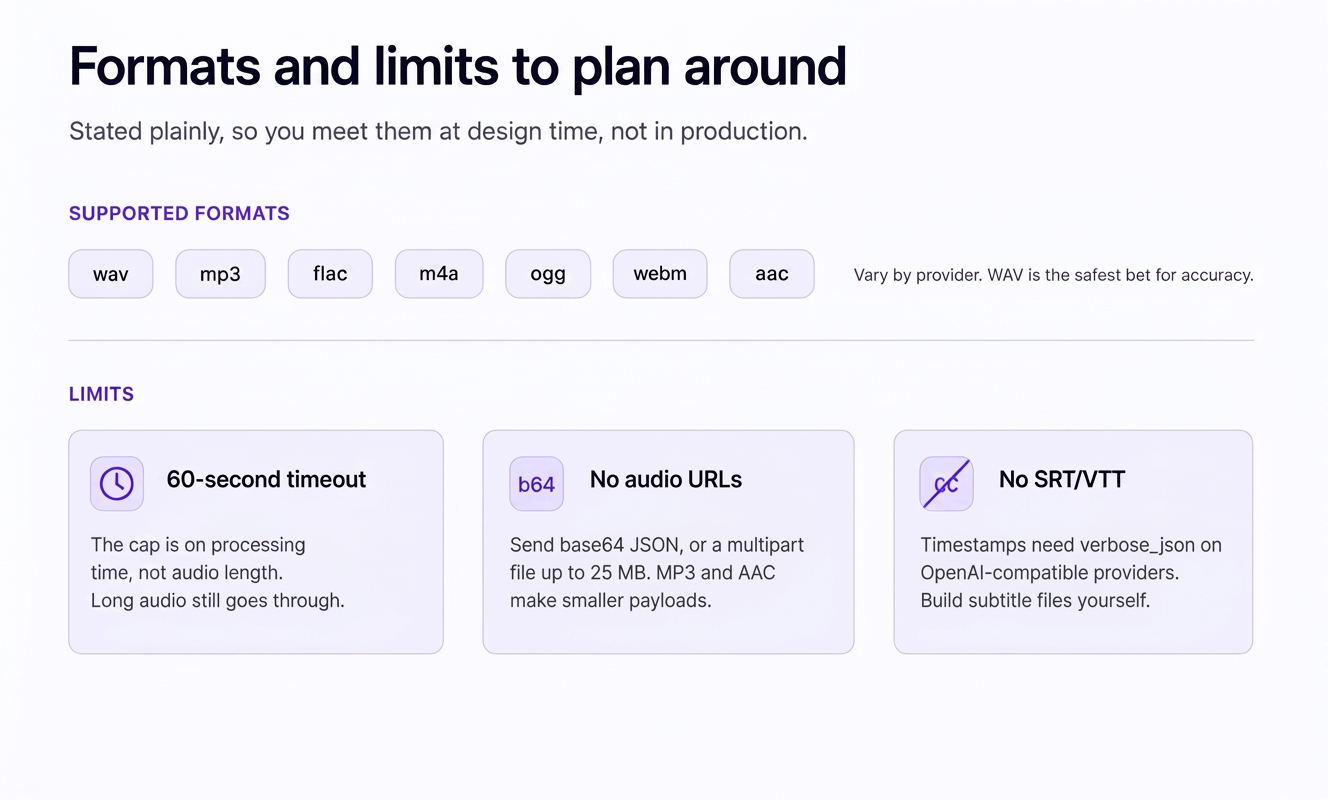
| Limit | What it means for you |
|---|---|
| 60-second upstream timeout | ~60 seconds of processing time, not a hard cap on audio length. Large or uncompressed recordings are the ones that time out. Split long audio into segments, transcribe each, and stitch the text. |
| No audio URLs | Audio can’t be passed by URL on this endpoint. Send base64 JSON, or an OpenAI-style multipart file up to 25 MB. Compressed formats (mp3, aac) make smaller, faster payloads. |
| No SRT/VTT output | srt, vtt, and text response formats are rejected with a 400. Timestamps are available via verbose_json on OpenAI-compatible providers; build subtitle files from those yourself. |
| Format support varies by provider | The list (wav/mp3/flac/m4a/ogg/webm/aac) is common, but a given model or provider may not accept all of them. wav is the safest default. |
Because the timeout caps processing time rather than audio length, a clip’s duration alone doesn’t tell you whether it will fit. A recording that runs for hours, like an overnight game session, needs the chunking treatment; a single call won’t cover it.
For captions, the default response is text plus usage with no timing. Set response_format to verbose_json and you get segment-level timestamps, plus word-level ones if you pass timestamp_granularities: ["word"]. That works on OpenAI-compatible providers (OpenAI, Groq, Together); other providers reject it with a 400. There’s no built-in .srt/.vtt output, so you build the subtitle file from the timestamps yourself.
What does a transcription request cost?
You pay the model’s catalog rate with no markup from us, and the usage.cost field tells you the exact figure per request. Whisper-class models charge per second of audio, and newer models charge per token.
Rates change, so we keep the live figure on each model’s page in the catalog rather than printing one here. Reading usage.cost off the response tells you what each request actually cost. STT models are paid, so API transcription draws on your credit balance.
To get started, confirm a model fits your audio in the Playground, wire up the call, and read usage.cost per request to meter spend from day one.
Frequently asked questions
How do I transcribe audio files with OpenRouter?
Send base64-encoded audio to POST /api/v1/audio/transcriptions with a model and an input_audio object (data plus format). The response is JSON with a text string (the transcript) and a usage object (seconds, tokens, and cost). It uses the same Bearer API key and auth as Chat Completions.
Does OpenRouter support Whisper?
Yes. Whisper-class models are available for transcription, and openai/whisper-1 is the slug to use. STT model IDs aren’t in the default /api/v1/models list, so you discover them by filtering with ?output_modalities=transcription or browsing the Speech-to-Text collection. Whisper is duration-priced, per second of audio; newer STT models price per token instead.
What audio formats does OpenRouter transcription accept?
The common set is wav, mp3, flac, m4a, ogg, webm, and aac, passed in the required input_audio.format field. Support varies by model and provider, so not every model accepts every format. wav is the safest default for broad compatibility; compressed formats like mp3 give smaller, faster payloads.
Can OpenRouter return timestamps or SRT/VTT subtitles?
Timestamps, yes. Set response_format to verbose_json to get segment-level timestamps, and add timestamp_granularities: ["word"] for word-level timestamps in a words array. That works on OpenAI-compatible providers (OpenAI, Groq, Together); other providers reject it with a 400. SRT/VTT output isn’t supported, so build subtitle files from the timestamps yourself.
How long can the audio be?
The practical limit is the roughly 60-second upstream processing timeout, not a fixed audio-length cap. Short and medium clips return in one call. For long recordings, split the audio into segments, transcribe each, and stitch the text together.
How much does transcription cost on OpenRouter?
You pay the model’s catalog rate with no markup. Whisper-class models price per second of audio; newer STT models price per token. The usage.cost field in each response reports the exact dollar cost of that request.